ITF Medium-Fast Court
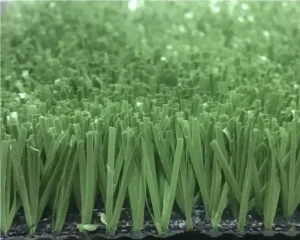
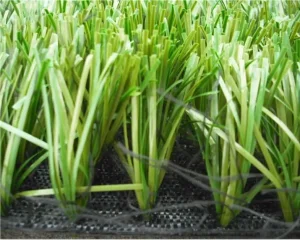
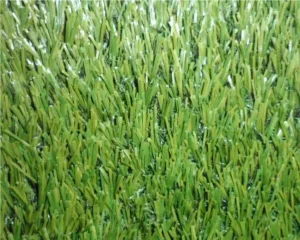
Pile: 15-20mm
UV 8000h
Oman Professional Tennis Turf Specifications & RFQ
Direct from the manufacturer: Precision-tufted, ITF-calibrated tennis turf surfaces configured specifically to withstand high solar UV indexes, desert particulate abrasion, and extreme diurnal temperature swings in the GCC region.
How Oman Vision 2040, severe water resource conservation laws, and multi-sector tourism infrastructure are redefining modern court architecture from Muscat to Salalah.
The Sultanate of Oman presents a uniquely demanding geographic, climatic, and structural operational environment for municipal, institutional, and private athletic infrastructure. Historically reliant on natural clay, porous concrete, or natural Bermuda grass courts, developers across the governorates of Muscat, Dhofar, Al Batinah North, and Ad Dakhiliyah are rapidly phasing out organic playing surfaces. The driving force behind this shift is deeply institutional: under the national mandates of Oman Vision 2040, municipal water supplies are strictly prioritized for human consumption, food security, and critical industrial processing. The maintenance of an 800-square-meter natural grass or red clay tennis court requires an estimated 1.8 to 2.5 million liters of desalinated water annually—an economically unsustainable overhead in a nation where water production heavily relies on energy-intensive reverse osmosis (RO) plants.
Consequently, commercial operators, sports federations, and luxury resort enclaves are transitioning toward synthetic tennis turf installations. In regional hubs such as Bousher, Al Amerat, Seeb, and Sohar, public sports facilities are undergoing systematic modernization. Synthetic sports grass eliminates daily irrigation requirements while providing consistent, predictable ball behavior compliant with the International Tennis Federation (ITF) Court Pace Rating (CPR). Concurrently, the booming hospitality and eco-tourism sector—centered around major international hotel operators in Salalah, Bandar Jissah, and the Musandam Peninsula—regards synthetic turf as an indispensable amenity. It ensures continuous operational readiness throughout high-occupancy winter seasons without degrading under hyper-saline maritime air or intense UV exposure.
On an industrial scale, the supply chain for artificial sports surfacing in Oman has evolved past the era of generic, non-specialized turf brokers. The Ministry of Culture, Sports and Youth, alongside private educational groups like Sultan Qaboos University and international schools, now enforces stringent procurement criteria. These specifications require third-party verification of polymer composition, heavy-metal non-toxicity, PFAS-free manufacturing certification, and tensile retention following accelerated weather testing. Supplying the Omani market demands deep engineering expertise to overcome high levels of airborne quartz dust, intense surface heat, and intense sand-infill abrasion.
Analyzing international synthetic turf advances: How modern TenCate monofilaments and micro-texturized fibers optimize kinetic performance and structural durability.
Traditional tennis turf utilized low-density polyethylene (LDPE) or basic polypropylene (PP) that became brittle after two seasons of Middle Eastern solar irradiation. Modern high-tier turf relies on specialized metallocene-catalyzed C4/C6 LLDPE polymers combined with premium block copolymers, retaining over 85% of their initial elongation and tensile modulus even under continuous heat.
Under the International Tennis Federation test standards, synthetic courts are classified from CPR Category 1 (Slow) up to Category 5 (Fast). Through fine-tuning fiber stitch densities (typically 44,100 to 52,500 stitches/m²), pile heights (12mm to 18mm), and infill gradation matrices, our manufacturing process provides tailored rebound angles and uniform coefficient of friction.
Thermal stability is governed by backing architecture. Our production lines feature multi-axial woven polypropylene fabrics reinforced with fleece membranes and coated with carboxylated styrene-butadiene (SBR) latex or high-grade polyurethane (PU). This prevents linear expansion, wrinkling, and seam failure when court temperatures hit 70°C under direct solar radiation.
Globally, synthetic tennis systems are categorized into two primary engineering methodologies: sand-dressed and sand-filled courts. Sand-dressed systems feature ultra-dense, shorter pile heights (12mm to 15mm) where the infill is embedded within texturized curl fibers, yielding an exceptionally uniform surface mimicking classic hard courts while providing joint-friendly elasticity. Sand-filled systems employ slightly taller pile profiles (15mm to 20mm), where high-purity, rounded silica quartz sand supports the fiber columns, reproducing the sliding mechanics, top-spin responsiveness, and ball bite characteristic of traditional clay courts, with zero moisture requirements.
| Performance Parameter | Sand-Dressed Professional System | Sand-Filled All-Weather System | Testing & Compliance Protocol |
|---|---|---|---|
| Typical Pile Height | 12 mm – 15 mm | 15 mm – 20 mm | ISO 2549 / EN 1969 |
| Fiber Polymer Structure | 100% PE Texturized Monofilament | PE / PP Fibrillated or Monofilament Core | ISO 1183 (Density & Polymer Melt) |
| Yarn Count (Dtex) | 6,600 – 8,800 Dtex | 8,800 – 12,000 Dtex | ISO 2060 / ASTM D1577 |
| Stitch Density (stitches/m²) | 44,100 – 52,500 / m² | 35,000 – 42,000 / m² | EN 12228 (Stitch Uniformity) |
| Infill Specification | 0.3 – 0.6 mm Rounded Quartz Sand (8-12 kg/m²) | 0.4 – 0.8 mm Washed Quartz Sand (18-25 kg/m²) | Dry Sieve ASTM C136 / Grain Roundness |
| ITF Pace Rating (CPR) | Category 3: Medium / Category 4: Medium-Fast | Category 1: Slow / Category 2: Medium-Slow | ITF CS/01/02 Court Pace Test |
| UV Degradation Resistance | > 8,000 hrs UVA/UVB exposure | > 6,500 hrs UVA/UVB exposure | ISO 4892-3 / DIN 53387 Tensile Check |
The transition toward eco-certified sports materials: Engineering non-toxic, recyclable, and thermally mitigated sports grass for next-generation Gulf infrastructure.
The global artificial turf sector is undergoing an environmental and chemical transformation. Regulatory shifts across the European Union (EU REACH amendments) and stricter North American EPA standards have positioned per- and polyfluoroalkyl substances (PFAS) at the center of regulatory attention. Historically used as processing processing aids (PPAs) in fluoropolymer extrusion to improve output rates, PFAS compounds persist indefinitely in the biosphere. As an export manufacturer supplying institutional infrastructure globally and within the Gulf Cooperation Council, we have eliminated PFAS-based processing aids across our production chains, achieving verified third-party PFAS-free certification.
Simultaneously, the industry is transitioning from legacy multi-material composites toward fully recyclable mono-material turf assemblies. Conventional turf backings rely on cross-linked SBR latex, which bonds dissimilar polymers (polyethylene fibers bonded to polypropylene fabric with thermoset latex), making mechanical recycling difficult at the end of court life. Modern advancements employ thermoplastic polyolefin (TPO) or pure polyurethane backings, enabling the entire synthetic court—fibers and backing alike—to be melted, pelletized, and recycled into high-performance industrial polymers without requiring secondary chemical peeling.
In arid Middle Eastern regions like Oman, surface heat accumulation remains a primary engineering challenge. Under midday solar irradiance exceeding 1,000 W/m², dark green synthetic surfaces can reach temperatures exceeding 75°C. To combat this, our polymer engineering integrates near-infrared (NIR) reflective masterbatch additives. By reformulating titanium dioxide (TiO₂) and advanced pigment chemistry, the turf reflects thermal radiation within the 700–2500 nm wavelength band instead of absorbing it. This proprietary formulation lowers field surface temperatures by 8°C to 12°C compared to conventional turf, significantly reducing thermal wear on both the player and the underlying polymer matrix.
Complete phase-out of fluorinated processing aids, integration of ISO 14001 environmental traceability, and deployment of 8,000-hour UV-stabilized hindered amine light stabilizers (HALS) suited to high desert solar irradiance.
Commercialization of CoolTurf micro-reflective fibers lowering playing surface temperatures under direct solar gain, combined with 100% recyclable polyolefin backings that eliminate chemical separation steps.
Integration of sugarcane-derived bio-ethylene polymers delivering carbon-negative footprints, paired with sensorized sub-base drainage pads monitoring shock attenuation and moisture dissipation in real time.
Every governorate across the Sultanate requires tailored synthetic court parameters to combat extreme heat, shifting sands, coastal salt humidity, or mountain rain.
Climatic Factor: Extreme summer humidity exceeding 85%, high ambient heat (45°C), and constant airborne sodium chloride (sea mist).
Engineering Solution: Polyurethane-backed, texturized monofilament synthetic turf with stainless-steel or non-corrosive anchoring systems. Highly impervious to hydrolytic breakdown, mitigating mold, fungal growth, and backing delamination along coastal residential and resort facilities.
Climatic Factor: Extreme diurnal thermal swings (-2°C winter nights to 48°C summer days), airborne silica micro-dust, and scouring winds.
Engineering Solution: Heavy-gauge diamond monofilament fibers paired with specialized anti-compaction texturized thatch. Dense quartz infill prevents fine desert dust from clogging base voids, preserving uniform ball bounce and player foot stability.
Climatic Factor: Prolonged seasonal drizzle, high soil saturation, overcast dampness, followed by intense tropical sun.
Engineering Solution: High-permeability perforated backing systems (drainage rates > 180 liters/min/m²) installed over porous macadam bases. Prevents surface pooling and rot during the Khareef, allowing immediate resumption of play when dry.
Climatic Factor: Steep gradient installations over limestone bedrock, strong UV exposure at higher elevations (Jebel Akhdar, Jebel Shams).
Engineering Solution: Integrated micro-cellular shockpad underlays (8mm to 10mm cross-linked closed-cell PE foam) compensating for substrate hardness, delivering maximum HIC (Head Injury Criterion) safety and joint-impact protection for private estates and luxury hotels.
A sports surface is only as stable as its foundation. Discover how we guide civil contractors through sub-base preparation, drainage design, and infill selection.
In civil sports engineering across Oman, court failures are rarely attributed to fiber yarn breakage alone. Instead, surface issues often originate from sub-grade settlement, expansive clays, or improper infill selections. When designing an all-weather tennis court in desert and semi-arid terrain, civil contractors must follow a structured multi-layer engineering protocol:
Arid soils in Oman often contain high fractions of wadi silt or loose alluvial sands. The sub-base must be excavated to a depth of 300–450mm, proof-rolled to a minimum of 98% Modified Proctor density, and lined with a continuous, non-woven polypropylene geotextile membrane (minimum 150 g/m²) to prevent migration of sub-grade fines upward into the aggregate base.
For municipal and private courts, an unbound dual-layer crushed limestone or gabbro aggregate system is installed (150mm dynamic base 20–40mm, overlaid by 50mm leveling layer 5–10mm). In high-tier tournament courts, a porous open-grade asphalt binder course (macadam) is preferred, providing millimeter-precise planarity (tolerance < 3mm under a 3m straight edge) and zero settlement.
Standard building sands or crushed desert dune sand must never be used on synthetic tennis grass. Their irregular, sharp edges cut through the turf fibers under player foot torque. Instead, we specify high-purity (minimum 98% SiO₂), washed, kiln-dried, rounded quartz sand (grain size 0.3mm to 0.8mm). The rounded shape allows fibers to pivot freely without slicing the polymer base.
Furthermore, perimeter anchoring in Omani installations requires reinforced concrete tension curbs (ring beams) measuring 150mm × 250mm around the court’s entire perimeter. The synthetic turf is secured using exterior-grade polyurethane adhesive adhesives and non-corroding marine-grade aluminum or stainless-steel mechanical clamping bars. This secures the surface against lifting during seasonal desert thermal storms (shamal winds) that can gust over 80 km/h.
Direct technical answers addressing commercial buyers, project architects, facility managers, and civil contractors.
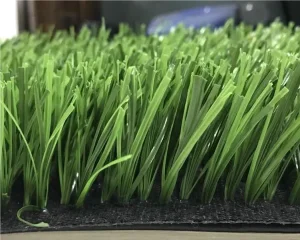
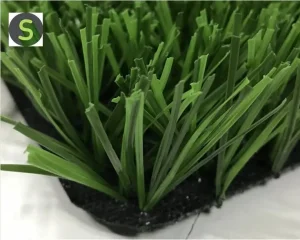
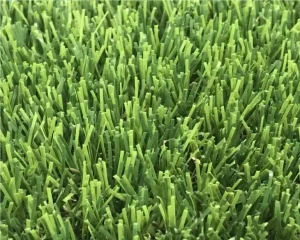
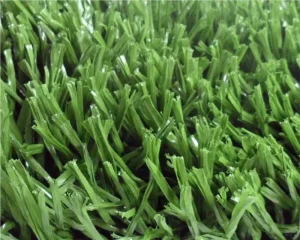
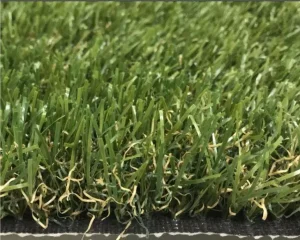
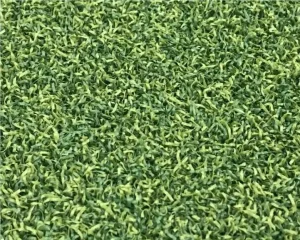
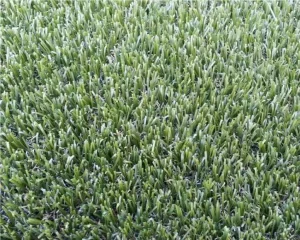
Explore our full manufacturing catalog: From FIFA-standard stadium football turfs to pet grass, playground safety systems, and putting greens engineered for regional commercial demands.
Connect with our senior technical engineers for direct container-load pricing, custom pile weight formulations, sub-base civil schematics, and full compliance sample kits delivered directly to your offices in Muscat or Salalah.
Send Inquiry Now