Engineered Sports Turf Catalog (Batch I)
Verified laboratory certifications, precision fiber extrusion, and multi-sport pitch systems.
Integrated Supply Chain Superiority of Chinese Turf Manufacturing
How upstream polymer petrochemical clusters and automated tufting ecosystems drive B2B cost-performance and volumetric capacity.
Vertical Polymer Aggregation
By co-locating raw C4/C6 LLDPE, PP masterbatch extrusion, and high-tenacity yarn drawing within immediate logistics radii, Chinese manufacturing clusters eliminate inter-facility transport tariffs and raw material handling margins. This vertical consolidation enables wholesale clients to achieve premium Dtex densities at 25-35% lower landed costs.
Advanced High-Gauge Tufting
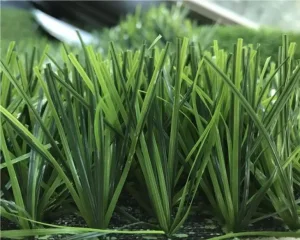
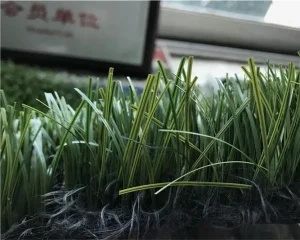
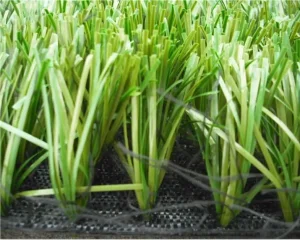
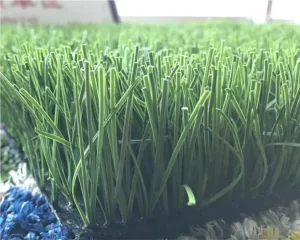
Equipped with computerized 3/8", 5/8", and 3/4" gauge tufting equipment operating with multi-needle cross-staggering, modern facilities seamlessly switch from dense 8,800 Dtex texturized putting surfaces to robust 16,500 Dtex diamond-core football fields, guaranteeing zero lateral shearing and consistent stitch density across 5-meter wide rolls.
Automated Coating Lines
State-of-the-art dual-furnace curing infrastructure supports both secondary carboxylated Styrene-Butadiene Rubber (SBR) latex compound distribution and solvent-free Polyurethane (PU) backing. Uniform immersion heating ensures exceptional tuft-lock adhesion values exceeding 45–55N, completely exceeding standard FIFA Quality pitch threshold requirements.
Global Enterprise Procurement Criteria
Deconstructing mechanical and chemical thresholds across international bidding mandates.
| Application Vector | Polymer & Cross-Section | Recommended Dtex & Gauge | Tuft Bind & Infill Matrix | Critical Compliance Test |
|---|---|---|---|---|
| Professional Soccer / Football | PE Monofilament (Diamond / Stem Shape) | 12,000 – 16,500 Dtex / 5/8" | >45 N Tuft Bind (Silica Sand + SBR/TPE) | FIFA Quality Pro Lisport XL 6,000 Cycles |
| Institutional Baseball Turf | High-Density Texturized PE/PP Hybrid | 9,000 – 11,000 Dtex / 3/8" | Secondary PP Cloth + PU / High Resilience | ASTM F355 G-Max Shock Absorption <110 |
| Championship Hockey Turf | High Tenacity Texturized PE / KDK Crimp | 7,500 – 8,800 Dtex / 3/16" Dense | Unfilled Water-based / Short Pile 12mm | FIH Global Standard Ball Roll & Deviation |
| Multi-Sport Municipal Pitches | Fibrillated or Multi-Shape PE Hybrid | 8,800 – 13,000 Dtex / 5/16" or 3/8" | Reinforced Fleeced Backing / Low Infill | EN 15330-1 Multi-Use Surface Integrity |
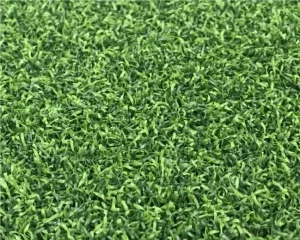
| Commercial Putting Greens | Non-Directional Crimped PP / Nylon (PA) | 5,500 – 8,000 Dtex / 3/16" Ultra-Dense | Heavy Latex Compound / True-Stimp Sand | USGA Stimp 10-12 Directional Consistency |
Engineering Note: Suntex Sports-Turf (Kunshan) Corporation collaborates with parent group RiThai International (nylon monofilament masters since 1977) and authorized TenCate yarn lines to ensure all polymer formulas resist thermal degradation up to UV-A and UV-B 5,000-hour exposure ratings without fiber embrittlement.
Localized Support & International Regulatory Compliance
Bridging overseas factory manufacturing with turn-key local installation, engineering, and environmental validation.
PFAS-Free & Non-Toxic Chemistry
Strict regional laws (such as EU REACH, California Prop 65, and evolving EPA PFAS mandates) require full elimination of intentionally added per- and polyfluoroalkyl substances. Our factory holds accredited third-party test verification showing undetectable fluorine levels, heavy-metal safety (RoHS), and EN 71-3 compliance.
ISO Integrated Quality Management
Production cycles run under triple-certified controls: ISO 9001 for dimensional tolerance & tensile verification, ISO 14001 for circular scrap reprocessing and closed-loop cooling, and ISO 45001 for occupational ergonomics, ensuring zero factory downtime on multi-container contracts.
CAD Cutting Plans & On-Site Support
To eliminate seam wastage in sports pitches, our engineering team supplies complete container packing manifests paired with CAD seam orientation layouts. We calculate roll length variations to fit 40ft High Cube containers without creasing, saving installation crews up to 14% on cutting labor.
Future Dynamics in Synthetic Sports Surfaces
Key technological disruptions guiding 2026–2030 facility development and turf procurement.
Non-Infill Multi-Sport Systems
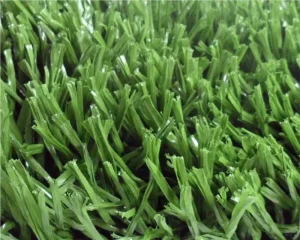
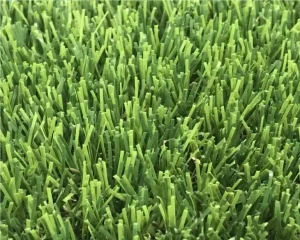
With municipal bans on loose microplastic infills (such as recycled crumb rubber), factories are prioritizing ultra-dense, multi-tier texturized thatch yarns that recreate shock attenuation and foot cleat grip without loose granular infill migration.
Mono-Polymer Circularity
Traditional multi-component turf (PE yarn with SBR latex and PP backing) creates severe end-of-life recycling barriers. Next-generation 100% Polyolefin mono-material carpets allow total chemical breakdown and pelletization without separation costs.
Cooling Masterbatch Tech
Thermal absorption in extreme climates can push artificial turf temperatures beyond 65°C. Infrared-reflective mineral additives blended into the core monofilament during extrusion deflect sunlight, lowering surface temperatures by 8°C to 12°C.
Bio-Mechanical Injury Prevention
Smart profile geometries (diamond with dual support ribs) balance rotational torque and linear sliding resistance, lowering ACL strain in high-impact varsity soccer, rugby, and multi-use school facilities.
Localized Engineering Application Scenarios
Engineered turf formulations custom-built for environmental and operational realities.
School & Municipal Multi-Play Fields
Engineered for high utilization exceeding 50 playing hours per week. Utilizing high-resilience diamond monofilament with low-friction coatings, these fields accommodate soccer, lacrosse, and track practice without premature fiber fibrillation.
High-Drainage Pet & Agility Parks
Featuring short 20-30mm dense blades with 100% permeable open-hole secondary backing or fully porous PU membranes, enabling liquid drainage rates exceeding 500 inches/hour to maintain hygienic conditions under daily animal use.
Resort Golf Greens & Commercial Landscape
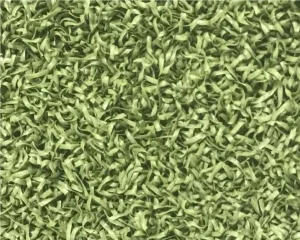
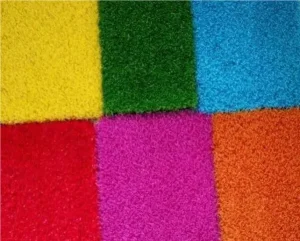
Non-directional texturized PP surfaces designed for tournament-grade ball roll (Stimp reading 10.5–12.0) paired with multi-tone curly thatch landscaping grass that withstands intense foot traffic without synthetic shine.
Engineered Sports Turf Catalog (Batch II)
Landscape solutions, specialized athletic builds, and playground surfaces.
Wholesale Sports Turf Q&A (FAQ)
In-depth responses to technical, regulatory, and supply chain queries encountered by international project leaders.