Engineered Sports & Golf Precision Turf Solutions
Explore high-impact putting and multi-sport synthetic turf formulations tested under extreme physical, tensile, and meteorological stress factors.
Global Chipping Green Engineering & Macro-Economics
The global sports surfacing ecosystem is undergoing an unprecedented transition driven by ecological regulations, water conservation mandates, and precision micro-climate performance demands.
Water Scarcity & Environmental Shocks
Traditional natural grass greens require over 500,000 gallons per acre annually in arid golf belts like the US Sunbelt, southern Europe, and MENA. Municipalities and course developers are rapidly shifting toward synthetic chipping complexes to meet strict ESG mandates while cutting operational overhead by up to 68%.
True Ball Dynamics & Kinetic Spin
Early-generation synthetics failed to replicate the checking action of a 60-degree wedge shot. Modern outdoor chipping greens solve this through dual-component infill systems—combining graded rounded quartz sand with vulcanized elastomer crumbs that recreate organic rootzone deceleration.
Multi-Faceted Hospitality & Urban Growth
Off-course golf entertainment venues, high-density residential developments, and boutique resorts are deploying short-game chipping arenas as social centerpieces. These environments require continuous foot-traffic resistance that would destroy natural creeping bentgrass within days.
Engineered Deployment Scenarios for Outdoor Chipping Greens
Strategic turf specification must adapt to real-world mechanical loads, climatic profiles, and player impact physics.
Private Estate & Custom Residential Arenas
Tailored for private villas requiring short-game ranges from 10 to 60 yards. Integrated fringe turf handles variable lofted wedges, providing natural divot resistance and consistent checking action without turf scarring.
Commercial Golf Academies & Practice Ranges
Engineered for high-volume commercial practice facilities running 12-hour daily cycles. Fiber matrixes deliver genuine ball-spin feedback across chip-and-run, flop, and bunker transition scenarios without compaction fatigue.
Luxury Hospitality & Rooftop Installations
Engineered for rooftop amenities, boutique hotels, and luxury resorts where drainage and structural weight matter. Incorporates custom free-draining multi-hole backings paired with lightweight structural shock pads.
Engineering Specifications: Chipping vs. Putting vs. Landscape
A rigorous breakdown of polymer densities, pile heights, and mechanical properties engineered to guide B2B procurement and commercial architectural specifications.
| Application Tier | Optimal Pile Height | Yarn Polymer & Geometry | Stitch Density / SQM | Infill Formulation | Target Mechanical Metric |
|---|---|---|---|---|---|
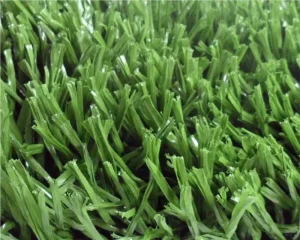
| Professional Chipping Target | 15mm – 20mm | Texturized High-Dtex PE & PA Core | 63,000 – 78,000 / m² | 60% Silica Sand + 40% TPE/EPDM | Shock Absorption > 58% (Vertical Force) |
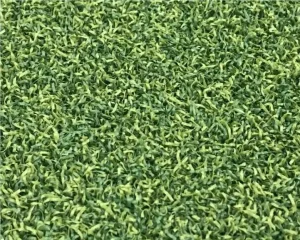
| Tournament Putting Surface | 12mm – 15mm | Fibrillated PP or Texturized PE | 75,000 – 88,000 / m² | 100% Kiln-Dried 40/70 Mesh Quartz | Consistent True-Roll Stimp (10.5 – 12.0) |
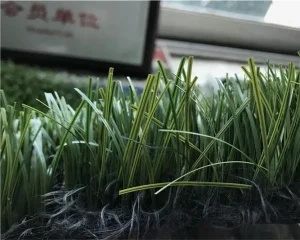
| Chipping Apron & Fringe | 25mm – 35mm | Monofilament C/W-Shape + PE Thatch | 18,900 – 25,200 / m² | 100% Coarse Sand Stabilizer | Clubhead Friction Replication / Flop Play |
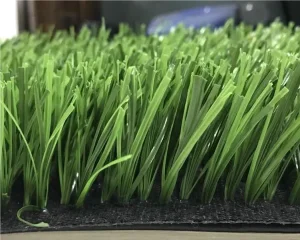
| Multi-Sport Surface | 20mm – 30mm | Diamond PE Monofilament Core | 21,000 – 29,400 / m² | Sand & SBR Elastic Layer | EN 15330 Multi-Sport Compliant Traction |
| Heavy-Duty Rough Buffer | 40mm – 55mm | Reinforced Spine PE Monofilament | 14,700 – 18,900 / m² | Optional Sand Layer (Ball Retainer) | Natural Recovery Memory Against Lie Down |
Chinese Manufacturing Resiliency: The Precision Factor
Leveraging five decades of polymer monofilament engineering heritage, vertical integration, and deep logistical infrastructure to minimize landed costs and delivery risk.
Vertical Polymer Upstream Synthesis
By controlling masterbatch preparation, specialized UV stabilizer compounding, and precision extrusion in-house, we eliminate the third-party markups and formulation variances common among regional assemblers.
High-Density Gauge Tufting Technology
Operating high-speed 3/16-inch and 1/8-inch tufting machinery delivers extreme stitch densities (up to 88,000 stitches/m²). This tight grain construction prevents ball tracking channels, ensuring roll consistency from every entry angle.
Multimodal Port Access & Containerization
Located near major deep-water ports, our automated rolling, bagging, and high-cube container packing systems minimize dead freight space, lowering international ocean shipping costs per square meter.
Material Innovation: Next-Generation Chipping Surface Roadmap
A multi-year development path advancing thermal management, circular economy recyclability, and sensor-embedded feedback systems.
Cooling Core Polymers
Infusing infrared-reflective nanoparticles directly into the polyethylene masterbatch, reducing surface temperatures by up to 12°C under direct summer UV exposure.
Circular Pure-Polymer Systems
Developing fully mono-component backing systems where yarn, primary backing, and secondary coating share the same polymer family, enabling 100% closed-loop recycling at end of life.
Biodegradable Infill Formulations
Replacing traditional elastomeric granules with plant-based, microplastic-free infills engineered to maintain resilience while meeting evolving EU microplastic restrictions.
Embedded Telemetry Sensors
Integrating micro-thin piezoelectric sensor films beneath the turf backing to measure club impact velocities, ball landing forces, and rollout trajectory patterns in real time.
Global Standards Compliance & Regional Engineering Support
Every commercial development requires documented compliance to pass architectural reviews, environmental impact assessments, and municipal bids.
PFAS-Free & Heavy-Metal Verifications
All yarns undergo certified testing against European EN 71-3, REACH Annex XVII, and US EPA Method 537 guidelines, verifying zero intentionally added fluorinated substances (PFAS/PFOS) or extractable heavy metals.
DIN & FIFA Equivalent Fire & Wear Tests
Tested under rigorous DIN EN 13501-1 fire reaction standards and accelerated Lisport 50,000-cycle mechanical stress profiles, ensuring turf meets building codes for both indoor atriums and exterior landscapes.
Architectural CAD & Base Design Support
Our engineering support team delivers turnkey cross-sectional CAD drawings, drainage porosity schematics, and sub-base aggregate load calculations tailored to regional freeze-thaw cycles and heavy rain conditions.
Enterprise Buyer Inquiries: Outdoor Chipping Greens
Clear, engineering-driven answers to frequent questions from project architects, sports surface installers, and bulk import buyers.
True check and spin response relies on a matched pairing of turf density and sub-base elasticity. Lofted wedge shots bite through a calibrated layer of rounded quartz sand and crumb infill, which absorbs incoming vertical impact energy similarly to natural turf rootzones.
Nylon delivers superior resilient memory under frequent, high-impact wedge shots, making it ideal for compact academy target greens. However, modern lubricated PE blends offer softer feel, better natural ball roll, and greater resistance to moisture-induced expansion in humid climates.
Our surfaces feature standardized 10cm x 10cm grid drainage perforations delivering water evacuation rates above 60 liters/minute/m². When installed over an open-graded crushed aggregate dynamic stone base, surface ponding is eliminated even during heavy rainfall events.
Standard inventory specifications require an MOQ of 500 m². Fully customized OEM runs—including bespoke pile heights, multi-color yarn blending, branded backing prints, and roll-width optimization—start at 1,500 m² with rapid CAD prototyping within 72 hours.
Commercial Multi-Category Synthetic Solutions
Complete product spectrum covering landscape stabilization, FIFA-grade athletic fields, and custom private installations.