High-Performance Synthetic Surface Solutions
Explore our premium-grade synthetic turf varieties engineered for professional baseball ballparks, golf greens, multi-sport arenas, and commercial athletic facilities.
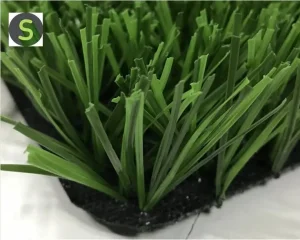
Macro Dynamics in Baseball Turf Procurement
A systematic analysis of enterprise-level decision factors driving the conversion from natural clay/sod to engineered synthetic systems across competitive leagues.
Severe Wear Resistance & Cleat Dynamics
Baseball subjects specific zones—the batter’s box, catcher’s area, and infield baselines—to intense cleat shear stress. Procurement directors must specify high-dtex monofilament fibers (up to 16,000 Dtex) coupled with high-density secondary backing to eliminate premature rutting and fiber degradation.
Predictable Ball Rebound & Pace Consistency
Unlike soccer, baseball requires absolute predictability in low-angle true ball roll and vertical rebound velocity. Advanced dual-component fiber texturizing prevents infill migration, ensuring fielders receive consistent hops from infield grounders regardless of climatic temperature variations.
Total Lifecycle Cost (TCO) Amortization
While the initial CAPEX of an engineered synthetic baseball complex is substantial, the elimination of clay laser grading, soil amendments, seasonal re-seeding, and excessive municipal irrigation creates complete payback within 3.5 to 5 operating years.
Baseball Field Subsystem Specification Guide
Standardized technical parameters for outfield, infield, warning track, and bullpen systems based on biomechanical impact testing and ball reaction physics.
| Field Zone | Recommended Pile Height | Fiber Cross-Section | Yarn Matrix & Dtex | Infill Specification | Critical Performance Spec |
|---|---|---|---|---|---|
| Infield Skin Zone | 25 mm – 32 mm | Texturized Slit-Film / Rib | PE + Heavy Thatch (12,000 Dtex) | Fine Sand + Engineered EPDM/TPE | Slide-friendly coefficient of friction; minimal bounce drift |
| Outfield Turf | 40 mm – 50 mm | Monofilament C-Shape / Diamond | TenCate Polyethylene (10,000–12,000 Dtex) | Rounded Silica Sand (70%) + SBR/Cork (30%) | High energy attenuation; superior vertical drainage (>300 mm/hr) |
| Pitcher Mound & Batter's Box | Custom / Heavy Duty Dual-Mat | Ultra-Dense Texturized Nylon (PA) | High-Tensile Polyamide (16,000 Dtex) | Dense sand packing or no-infill heavy backing | Extreme puncture resistance to metal spikes; non-displacement |
| Warning Track | 30 mm – 40 mm | High-contrast Monofilament | UV-Stabilized Terra-Cotta PE (9,000 Dtex) | 100% Silica Sand ballast | Audible and tactile underfoot transition cues for fielders |
Technological Roadmaps & Sustainable Innovation
Next-generation polymer science addressing the micro-plastic directives, end-of-life circularity, and heat island mitigation in elite sports facilities.
PFAS-Free & Eco-Toxicity Compliance
Under tightening global chemical regulations (EU REACH and US State-level EPA frameworks), Suntex produces 100% fluorochemical-free synthetic fibers. Certified non-leaching formulations guarantee zero contamination of surrounding aquifer basins.
Thermoregulation & Infrared Reflectance
Surface temperatures on standard synthetic sports pitches can exceed natural sod by up to 25°C. Next-gen polymer additives utilize infrared-reflective pigments to scatter sunlight wavelengths, systematically lowering field temperatures by 8°C to 12°C for athlete safety.
Circular Economy & Monomaterial Backing
Traditional turf systems fuse polyurethane (PU) or latex coatings to polyolefin yarns, making mechanical recycling difficult. Suntex’s innovative 100% Polyolefin Monomaterial Backing enables direct melt-reprocessing into secondary industrial resins at end-of-life.
Localized Support & Tier-1 Global Compliance
Suntex Sports-Turf provides fully integrated OEM, technical submittal assistance, and certified supply chains for municipal tenders and franchise ballparks.
Direct OEM Engineering & Private Label
From tailor-made roll lengths matching precise field layouts (minimizing cut waste) to customized line-tufting for baseline and batter's box integration, our factory delivers build-to-order manufacturing for global brands and municipal contractors.
Turnkey Sub-Base Engineering Consultation
A sports surface is only as stable as its aggregate foundation. We supply comprehensive engineering packages detailing civil sub-base requirements: dynamic laser grading tolerances, geogrid stabilization, dynamic shock pads, and perimeter trench drainage.
Rapid Logistics & Container Optimization
Exporting to over 30 countries across the Americas, Europe, Middle East, and Asia-Pacific. Automated core winding ensures high packaging density, while moisture-barrier multi-ply wrapping protects roll integrity through transatlantic transport.
Enterprise Baseball Surface Questions & Answers
Technical clarity for specifiers, sports field architects, and stadium operators.
How does baseball synthetic turf handle player sliding abrasions?
Modern baseball turf systems utilize low-friction Polyethylene (PE) monofilaments treated with specialized polymers rather than old abrasive nylons. In areas subjected to continuous sliding (home plate and infield bases), high-density texturized fibers support player cleats while maintaining skin-friendly non-burn performance verified by EN 15306 standards.
What is the typical lifespan of a full synthetic baseball field?
With TenCate fiber integration and routine maintenance (infill de-compaction, grooming, and high-wear zone replenishment), enterprise synthetic baseball systems regularly deliver an operational life of 8 to 10+ years, even under intensive multi-team collegiate and municipal schedules.
Can artificial turf replicate natural ball bounce in the infield?
Yes. By pairing dual-shape monofilament fiber blends with a calibrated dual-density sand/rubber infill balance and an underlying performance pad, ball bounce coefficient and rolling friction closely match high-caliber MLB-level Kentucky bluegrass and clay infield mixtures.
How does drainage compare to conventional grass under heavy rain?
Standard synthetic systems feature punch-hole or fully porous unitary backings delivering vertical hydraulic conductivity exceeding 500 mm per hour. Games can restart within 15 minutes of torrential rainfall without puddling, eliminating rained-out cancellations and rescheduled series.
Commercial Athletic & Specialized Turf Series
Explore our industry-certified turf catalog engineered for high wear, multi-sport agility, and all-weather resilience.